Saturday, February 12, 2022

Dividend Income Update - January 2022


The month of January 2022 is another month of dividend income landing in my accounts.

Due to becoming debt free, I changed my pay myself model. Starting the beginning of August 2021. I am paying myself 30%, just like before. This will now consist of 24% to investing, and 6% to savings. The investment portion is going to my TFSA. Any money left over at the end of the month, I put towards investing on top of the money allocated from paying myself first. Hopefully, I can keep this up!

Note: All the dividends and totals below are in Canadian Dollars


I received a total of $750.40 in dividend income for the month of January 2022. This is the first time I surpassed $700.00 in a single month in dividend income.  This represents a 9.74% increase from 3 months ago and 11.29% increase year over year.

I received dividend / distribution income from 15 different companies.

I received $0.00 in option premiums within my investment accounts in January 2022.

Below is a visual of my dividend totals for the last 5 years.

Click To Enlarge


Most of my dividend income comes from my margin account.

Click To Enlarge


Next, I will show the percentage of total income for each position.

Click To Enlarge


I will update my dividend income tab with the new amount. I will include my option premium income also. It is great to see money from passive income sources deposited into my brokerage account every single month.

Note: Any activity in my RRSP account is not included in these totals.

How was your dividend income for January 2022?

Disclosure : Long all mentioned securities

DISCLAIMER

I am not a financial planner, financial advisor, accountant or tax attorney. The information on this blog represents my own thoughts and opinions and should NOT be taken as investment or business advice.

Every individual should do their due diligence to make their own financial decisions based on their financial situation and tolerance for risk.

Sunday, February 6, 2022

Portfolio Update - January 2022

 The month of January 2022 is now behind us.

COVID continues to worry people and a lot of people want restrictions to remain in place. 

A truckers convoy was started in which truckers from across the national drove their trucks to Ottawa to protest vaccine mandates and , in particular, vaccine mandates at the US-Canada border.  For Canada truckers could go into the United States, but would have to quarantine upon returning to Canada after their Canada-destined load was delivered.  Unvaccinated US truckers would be turned around at the border.  The following week, the US implemented their mandatory vaccination.

A major issue with the convoy is noise disturbance.  Truckers are blowing their highway horns, which are a lot louder than regular horns for non-highway locations.  

The truckers are refusing to leave until the mandates are lifted.  Justin Trudeau has refused to meet with the truckers.

Portfolio Activity

Margin Account Activity

There was no activity in this account since the last portfolio update.  All the dividends remained in the account. 

TFSA Activity

There was no activity in this account since the last portfolio update.  Cash was added to the account. All the dividends remained in the account.   

Shares Purchased Via DRIP

1 unit  of BPF.UN.TO @ $15.29 for a total cost of $15.29 (TFSA)

3 shares of AQN.TO @ $13.8593US for a total cost of $52.06 CAD (TFSA)

0.719418 of BNS.TO @ $90.5454 for a total cost $65.14 CAD (Transfer Agent)

Boston Pizza Royalties Income Fund pays a distribution of $0.085 per unit monthly, or $1.02 per unit annually.  This drip adds $1.02 CAD  to my annual dividend income.  The yield on cost for this DRIP is 6.67%.

Bank of Nova Scotia pays a dividend of $1.00 per share quarterly, or $4.00 per share annually.  This drip adds $2.88 CAD to my annual dividend income.  The yield on cost for this DRIP is 4.42%.

Algonquin Power and Utilities pays a $0.1706 USD per share quarterly, or $0.6824 USD per share quarterly dividend.  This drip adds 2.04 USD to my annually dividend income.  This is equivalent to $2.61 in Canadian dollars.  The yield on cost for this DRIP for the Canadian dollar equivalent is 5.02%

I have some other positions with the DRIP turned on, but might not have enough of a dividend to purchase a whole share. 

My Enbridge position directly with the transfer agent is set up to DRIP.  Around November 2018, Enbridge stopped their DRIP program.  If Enbridge decides to start a DRIP, then my shares will start to DRIP again automatically.  

Please note that if some brokerages DRIP shares when there is no DRIP program by the actual company. This DRIP is when the brokerage buys the shares directly off the public market stock exchanges. 


Dividend Increases

On January 25,  Canadian National Railroad (CNR.TO)  increased their dividend from $0.615 to $0.7325 CAD per share quarterly, or from $2.46 to $2.93 CAD per share annually.  This is an increase of 19.1%.   

I own 38 shares of Canadian National Railway at the time of the increase.  This increase adds $17.86 CAD to my annual dividend income. 


Dividend Decreases

There was no dividend decreases in January 2022. 

Summary: 

As of February 5 2022 , the total value of the portfolio is $178572.12 . This is a 2.50% increase over last month's total. 

The portfolio is estimated to produce an estimated $6532.90 in dividend income over the next 12 months. This is an increase of $27.21  CAD , or 0.418
%. Some of the dividends in the Canadian stocks section are paid in US dollars, which are converted to Canadian dollars. 
  
Please Note: Positions in Restaurant Brands International (QSR.TO) , Intertape Polymer Group (ITP.TO), Brookfield Renewables Corporation (BEPC.TO), and Algonquin Power and Utilities (AQN.TO)  pay dividends in US dollars. Brookfield Renewables Partners (BEP.UN) pays distributions in US dollars. My investment tab spreadsheet displays the Canadian dollar equivalent within 15 to 20 minutes of real time. 

Note: Dividend increases or decreases announced in December 2021 will be mentioned in next portfolio update.  The spreadsheet will be updated to reflect any corresponding increases or decreases at that time. 

Disclosure: Long aforementioned stocks

               
DISCLAIMER

I am not a financial planner, financial advisor, accountant or tax attorney. The information on this blog represents my own thoughts and opinions and should NOT be taken as investment or business advice. Every individual should do their due diligence to make their own financial decisions based on their financial situation an
d tolerance for risk.

Friday, January 28, 2022

Savings Hack - Update #1

I recently wrote about a Savings Hack, and that trade #4 was still open. 

Trade #4 was a covered call expiring January 21, 2022.  The covered call was on ATD.TO with a strike price of $49.  I received a net premium of $139.05.  This option expired worthless as the stock traded below $49 at expiration.

After that post,  I did another trade. 

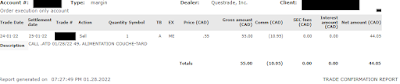
On January 24, I sold 1 Jan 28 2021 $49 Call at $0.55.  I received net premium of $44.05 after commissions.


Click to Enlarge


On January 28th, the option was assigned as it traded in the money at expiration.  When selling a call option, an option trading in the money means it trades above the strike price. 

Summary:

In the original Savings Hack article, trade number 2 is the ATD.TO purchase of 100 shares.  

Initial cost:  = $4829.95 
Option Assignment fee = $24.95
Net Option Premium = $44.05
Proceeds of Sale =  $4900.00

Profit =  Proceeds + premium - assignment fee - initial cost
         = $4900.00 + $44.05 - $24.95 - $4829.95
         = $89.15

This is capital gain I will report on taxes for the completion of this trade.

As per the above linked article, I transferred $300.18 to my savings.  This $89.15 will be sent to my savings account.  So that is a total of $389.33 to my savings.

DISCLAIMER

I am not a financial planner, financial advisor, accountant or tax attorney. The information on this blog represents my own thoughts and opinions and should NOT be taken as investment or business advice.

Every individual should do their due diligence to make their own financial decisions based on their
 financial situation and tolerance for risk.